I’m Orsolya Sarkadi-Kruk.
A UX researcher and UX/UI designer
Automate
Used car marketplace application based on AI
Time
17 weeks
(6 week theory + 11 week project)
School
Tools
Figjam, Figma,
Google Meet
Jotform, A.I. tools,
Google Slide
Summary
AutoMate, the application which revolutionize Hungary’s Secondhand Car Market with AI & Expertise. Our bootcamp project application is designed to help buyers find their perfect car in Hungary’s big secondhand market, where 821,000 vehicles were sold in 2023. Because 34% of these cars being 20 years old or older, navigating the market can be overwhelming—especially for inexperienced buyers.
Our solution mixes AI with human expertise to provide a seamless, trustworthy, and user-friendly experience. Supported by research and user insights, AutoMate simplifies the complex and time-consuming car-buying process, ensuring buyers make confident and informed decisions.
Introduction
Our mission was to create an app that helps users find the right car for their needs in the used car market, utilizing AI technologies.
Problem Statement
According to our desk research, people with limited experience in the car market struggle with existing platforms, as these require some level of expertise. The average buyer spends more than six weeks researching but still feels vulnerable to being scammed.
Goal
Our platform gathers information in one place, making it easy for users to find the right car type for their everyday needs. Additionally, users can connect with experts who can help them achieve their goals.


Research
Secondary research:
We conducted thorough desk research, including competitor analysis, market research, and gathering information from forums and chatrooms. We analyzed surveys and utilized AI tools.
Primary research:
We conducted 9 interviews
Hypothesis
-
The existing sites are hard to use if you don't know what you are looking for.
-
Buyers have to collect information from many sources, which is difficult and requires a lot of effort before they can even start their search.
-
There is general mistrust in the market.
-
People find it difficult to connect with a trustworthy expert for help.
-
People unfamiliar with AI don't trust it.
Data analysis
To synthesize the findings from our research, we created an affinity map to gain a deeper understanding of the user needs. Based on the insights from the nine interviews, we developed a user behavior map. This revealed two distinct user groups that clustered together: experts and inexperienced buyers.
We decided to focus our app on the inexperienced users, as they represent a larger potential user base. Vicky, our user persona, embodies the characteristics and needs of this primary user group.

User journey


Insights
Distrust:
Throughout the research, the issue of mistrust was a very important theme.
It was clear that buyers do not trust dealers.
Uncertainty:
Buyers have a great deal of uncertainty during the process. Because they do not have the ability to screen out potential defects in the cars they are buying.
Lack of assistance
The inexperienced users need help from the beginning of the process. Usually they will ask for help from a familiar person, but for some issues during the user journey they would need an expert to support them.
Artificial Intelligence (A.I.):
The summary of the results of our survey was that the people were unfamiliar with AI and they didn't have a lot of confidence in it. They were willing to use it, but only in a limited way.

Designing MVP
Onboarding / The first flow
After the research, we were sure we needed to hide the AI function, but we still felt it would help the user a lot. We made lot of sketches and storyboards and we had lot of ideas. At the end we decided to design a simple, user-friendly onboarding flow to help the user easily define their needs. We knew that the onboarding process was going to be the key to making it easier for the user to make the settings to shape the user interface for their needs.
Onboarding
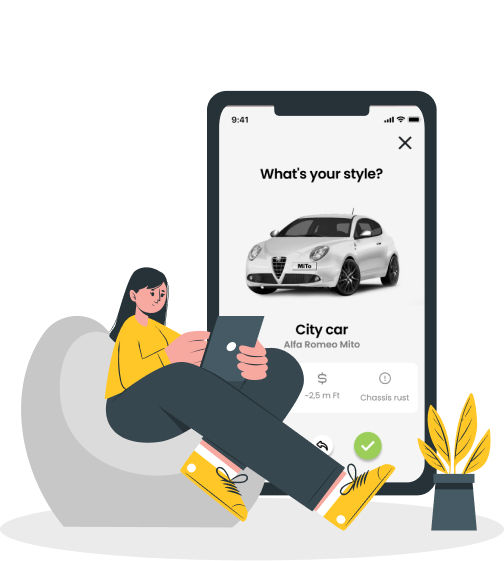
The goal of onboarding is to help users define their needs without painstaking research. The AI in the background helps to narrow down the search for the user's need.
At the end of the onboarding, the user receives AI-generated model suggestions. With the "car tinder" the user receives a model collection, which is the basis for the personalized offers from our ad database after registration.
With this flow, we are already providing some support and trying to encourage our future users to register.
Personal assistance / The second flow
Based on our research and the survey, we knew that users needed a human touch, someone with expertise who could help them if they got lost.
So we created a second and a third flow where our persona could book a personal call with a mechanic for an onsite visit when they meet live and inspect the car.



Usability testing
Once we had our prototype, we conducted usability tests with 5 target users. The users participated via Google Meet and successfully navigated the app. They completed 3 scenarios with the 2 flows.
First flow
In the first flow, new users had to go through onboarding. They found it mostly straightforward and easy. The generated car cards, however, were difficult for them to understand. We need to work on the car matching feature and make our intentions clearer to the user. So we redesigned the interface and changed the text.
Second flow
In the third scenario, the users had to call the mechanics and go through the checklist together. This turned out to be very difficult, they did not understand the checklist and the jargon. We had to rethink the checklist feature to make it easier to use. Based on our persona, the checking would be more on the mechanic's side, not the user's.

Feedback
At the end of our 11-week journey, we presented our project to the public. We received valuable feedback from experts as Zsu Barna Lead Service Designer at IdomSoft and Zoltán Kollin Design Principial IMB Cloud.
Here are some of their comments:
„The expert view and tinder preference sorting are very nice solutions..”
„It's great that you have realised the importance of the screener questionnaire and that you have experienced first hand the importance of pre-screening your interviewees.”

„I loved that instead of "hyping" AI, you found a good solution to the problem, which had the business side figured out, had technology in it, and even answered the user needs to the maximum. It's also a very senior solution: because users seem to be afraid of AI, it only works in the background, seemingly in the user's hands all the time.”
„Super interaction design solution for life situation/expectations based search, combined with like/dislike filtering - perfect solution.”